The Promised Neverland
- Timothy Dale

- May 25
- 5 min read
The Promised Neverland is a highly acclaimed Japanese dark fantasy and psychological thriller anime and manga series written by Kaiu Shirai and illustrated by Posuka Demizu. The narrative focuses on a group of brilliant orphaned children who discover a sinister truth about their idyllic upbringing and orchestrate a high-stakes escape.
Core Premise
The core premise of The Promised Neverland centers on a group of highly intelligent orphaned children living in a seemingly idyllic, pastoral orphanage called Grace Field House, only to discover that their home is actually a premium livestock farm where they are being raised as high-quality meat for demonic creatures.
At first, the children enjoy a perfect life. They are under the care of a loving, deeply affectionate caretaker they call "Mom" (Isabella). They spend their days wearing pristine white uniforms, eating gourmet meals, having plenty of playtime, and taking rigorous daily cognitive exams to foster their intellect. The only rule is that they must never go past the gated perimeter.
The story follows three of the oldest and smartest kids, Emma, Norman, and Ray. Their reality shatters when they try to return a forgotten stuffed animal to a sibling who was supposedly "adopted". At the forbidden gate, they discover her dead body and realize the terrifying truth: The orphanage is a farm.
The children are nothing more than pampered livestock, the daily academic tests are designed to maximize brain development, as the demons view highly developed human brains as a gourmet delicacy, and "Mom" is actually a loyal agent of the demons, actively monitoring and grooming them for slaughter.
The narrative transitions into a high-stakes, psychological cat-and-mouse game and survival thriller. Emma, Norman, and Ray must utilize their elite intelligence to outsmart their "Mom," secretly train their younger siblings, and coordinate a massive escape before their own upcoming birthdays seal their fatal harvest.
The overall core premise of The Promised Neverland series expands into a sociopolitical survival war between humanity and demons, where children must break a millennium-old geopolitical treaty to secure human liberation.
While Season 1 focuses on escaping a single farm, the broader series centers on the conflict between two distinct worlds and the deep-seated systems that maintain their separation. As the children escape into the outside world, they discover the hidden history of their reality.
Long ago, humans and demons fought a brutal, endless war. To stop the bloodshed, a treaty known as "The Promise" was forged 1,000 years ago. The earth was split into two separate dimensions: the Human World and the Demon World. As part of the peace deal, a small population of humans was left behind in the Demon World to be bred as livestock, ensuring the demons would never hunt humans in the Human World again. The protagonists are descendants of this original sacrifice.
The conflict is driven by a dark evolutionary secret. Demons do not just eat humans for pleasure; they eat them to survive. Without consuming human DNA, specifically from highly developed human brains, demons lose their intellect, mutate, and regress into mindless, wild beasts. The farming system is an institutional necessity to keep demon society civilized.
Key Themes
The Promised Neverland, created by writer Kaiu Shirai and illustrator Posuka Demizu, uses a dark fantasy thriller premise to explore complex philosophical, psychological, and social questions. While the narrative shifts from an intimate prison-break thriller to a grand fantasy rebellion, several core themes anchor the entire story.
Shattered Naivety: The series begins as an allegory for the brutal realization of how cruel the real adult world is. The children transition from a blissful, sheltered childhood into an environment where they are viewed merely as commodities.
Adult vs. Child Perspectives: The narrative constantly pits the pure, idealistic expectations of children against the cynical, compromised morals of the adults who manage them, such as Isabella.
Accelerated Maturity: To survive, the main trio must prematurely develop intense tactical, psychological, and analytical skills, effectively sacrificing their own childhoods to save others.
Societal Metaphor: The core twist, that the orphans are high-quality livestock raised for demons, serves as a striking mirror to industrial farming and capitalism.
The "Are We Any Different?" Dilemma: The series purposefully avoids painting all demons as inherently evil. By showing that the demon society relies on human meat to retain their intelligence and survive, the story asks the reader to reflect on how human society treats lower intelligent species and monopolizes resources.
Systemic Complicity: Characters like Isabella and Krone highlight how oppressive systems force the oppressed to cooperate and subjugate others just to survive within the hierarchy.
Norman’s Logic: Norman represents pragmatic utilitarianism. He is willing to commit demon genocide or sacrifice a few to guarantee the absolute safety of his family, believing that peace requires cold, calculated cruelty.
Emma’s Radical Empathy: Emma represents absolute moral idealism. She rejects any solution that requires discarding others, fighting for a world where humans and demons can co-exist without slaughter.
Ray’s Realism: Ray balances the two, evolving from a defeatist who accepted a partial escape to a protector willing to execute Emma's impossible ideals.
Breaking the Cycle: The characters refuse to accept the predetermined "destiny" laid out for them by the world's ancient pact.
True Liberty: Freedom is not just escaping physical walls; it is the right to choose one's future. The children reject comfortable captivity in favor of the dangerous, unpredictable pursuit of actual autonomy.
Family by Choice: The series redefines family. Blood relations do not matter; their deep, unbreakable bond and mutual aid form the ultimate foundation of their strength to rewrite fate.
Characters
The primary characters of The Promised Neverland center around Emma, Norman, and Ray, including the caretakers and various factions they encounter across the series.
The Main Trio
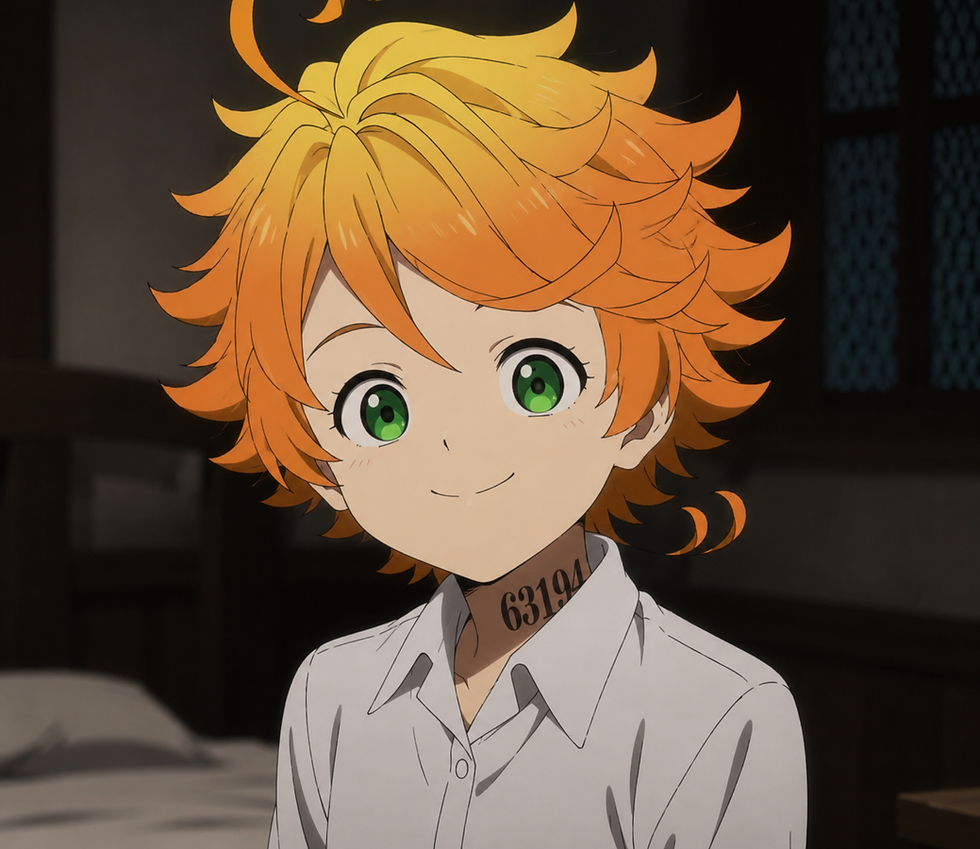
Emma: The optimistic, deeply empathetic protagonist who refuses to leave any child behind.
Norman: The prodigy strategist who uses genius-level logic to secure his family's survival.
Ray: The pragmatic realist with a sharp mind who acts as the group's essential realist.
Grace Field House
Isabella (Mama): The highly intelligent and complex main caretaker who grooms the orphans for harvest.
Krone (Sister Krone): The ambitious assistant caretaker who secretly aims to usurp Isabella's position.
Don: A loud, hot-headed, and deeply caring older boy who helps lead the escape.
Gilda: A quiet, analytical, and highly perceptive older girl who acts as a core leader.
Nat: A narcissistic but reliable boy who loves playing the piano.
Anna: A kind-hearted, observant girl who later develops vital medical skills.
Thoma and Lani: A mischievous duo of close friends who support the older kids.
Phil: A highly observant 4-year-old left behind to watch over the toddlers.
Conny: The innocent girl whose early adoption exposes the dark truth of the orphanage.
Sherry, Mark, Maira, Alicia, and Jasper: Younger children who escape or await rescue.
The Ratri Clan
Peter Ratri: The ruthless current head of the clan who maintains the ancient promise.
James Ratri (William Minerva): The former head who left hidden clues to guide the escaping children.
Andrew: A lethal enforcer tasked with hunting down the escaped orphans.
The Lambda 721 Experiments
Vincent: A highly intelligent, calculating escapee from the Lambda facility.
Cislo and Barbara: Fierce fighters who hate demons due to brutal experimentation.
Zazie: A silent, physically massive fighter who wears a paper bag over his head.
The Demon Faction
Mujika: A rogue, compassionate demon who does not eat humans and helps the children.
Sonju: A skilled warrior demon and Mujika's companion who guides the trio.
Lewis (Archduke Leuvis): A terrifying, battle-hungry aristocrat from the Goldy Pond hunting ground.
The Demon Royalty: Queen Legravalima and the Five Regent Houses who govern the demon world.
The One (Him): The mysterious, god-like deity of the demon world who holds the ultimate Promise.



Comments